
Replacing a missing tooth is about more than just aesthetics—it’s crucial for maintaining your oral health, jawbone density, and chewing ability. While traditional bridges and dentures have long been standard solutions, dental implants are considered the gold standard for long-term tooth replacement.
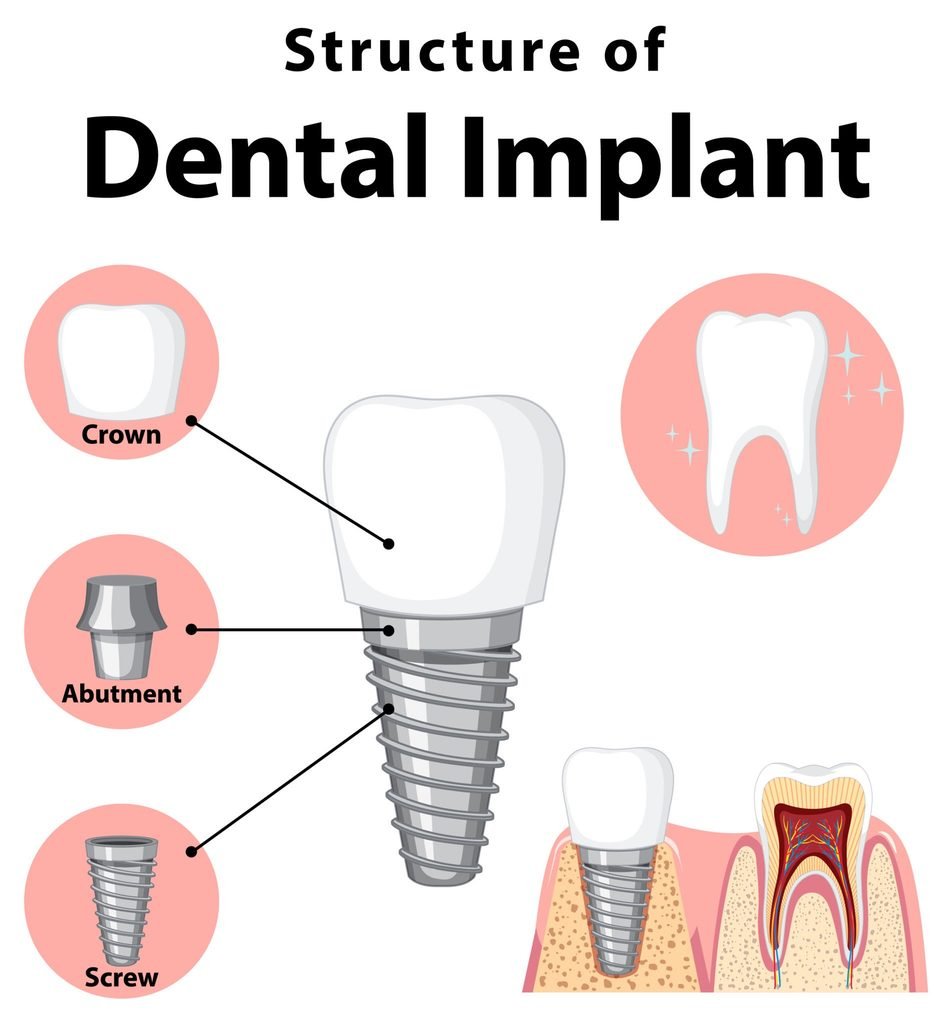
Anatomy of a Dental Implant
A dental implant consists of three main components engineered to mimic the natural function of a real tooth root and crown:
- The Implant (Screw): A biocompatible titanium post placed surgically into the jawbone, serving as an artificial tooth root.
- The Abutment: A connector piece attached to the top of the implant post that securely holds the replacement tooth.
- The Prosthetic (Crown): A custom-crafted ceramic or zirconia crown that matches the shape and shade of your adjacent natural teeth.
The 4-Step Dental Implant Journey
1.1. Consultation & Treatment Planning:Prerequisites: CBCT 3D Scan & Bone Assessment.
Your dentist evaluates your bone density and overall oral health using 3D digital imaging (CBCT scan) to plan exact implant placement and determine if pre-treatment (like bone grafting) is necessary.
2.2. Implant Placement Surgery:Duration: ~45–90 minutes | Local Anesthesia.
The titanium post is surgically embedded into the jawbone. A protective healing cap is placed, and the area is allowed to heal.
3.3. Osseointegration & Healing:Timeline: 3 to 6 months post-surgery.
During this critical phase, your natural jawbone fuses directly with the titanium surface (osseointegration), creating a solid foundation for the permanent tooth.
4.4. Abutment Placement & Final Crown Fitting:Final Phase: Custom Shade Matching.
Once integrated, the abutment is attached, and a custom-made crown is placed on top to complete your smile.
Dental Implants vs. Traditional Options
| Feature | Dental Implants | Traditional Dental Bridge | Removable Dentures |
| Lifespan | 15–25+ years (often lifetime) | 7–10 years | 5–7 years |
| Preserves Healthy Teeth | Yes (standalone replacement) | No (adjacent teeth must be reshaped) | Yes |
| Prevents Bone Loss | Yes (stimulates jawbone) | No | No |
| Chewing Efficiency | ~95% (feels like natural teeth) | ~70% | ~30–40% |